Panch Kedar: The Five Sacred Temples of Lord Shiva in Uttarakhand
A detailed guide to Kedarnath, Madhyamaheshwar, Tungnath, Rudranath and Kalpeshwar — their legends, history, routes, trekking experience and spiritual significance.
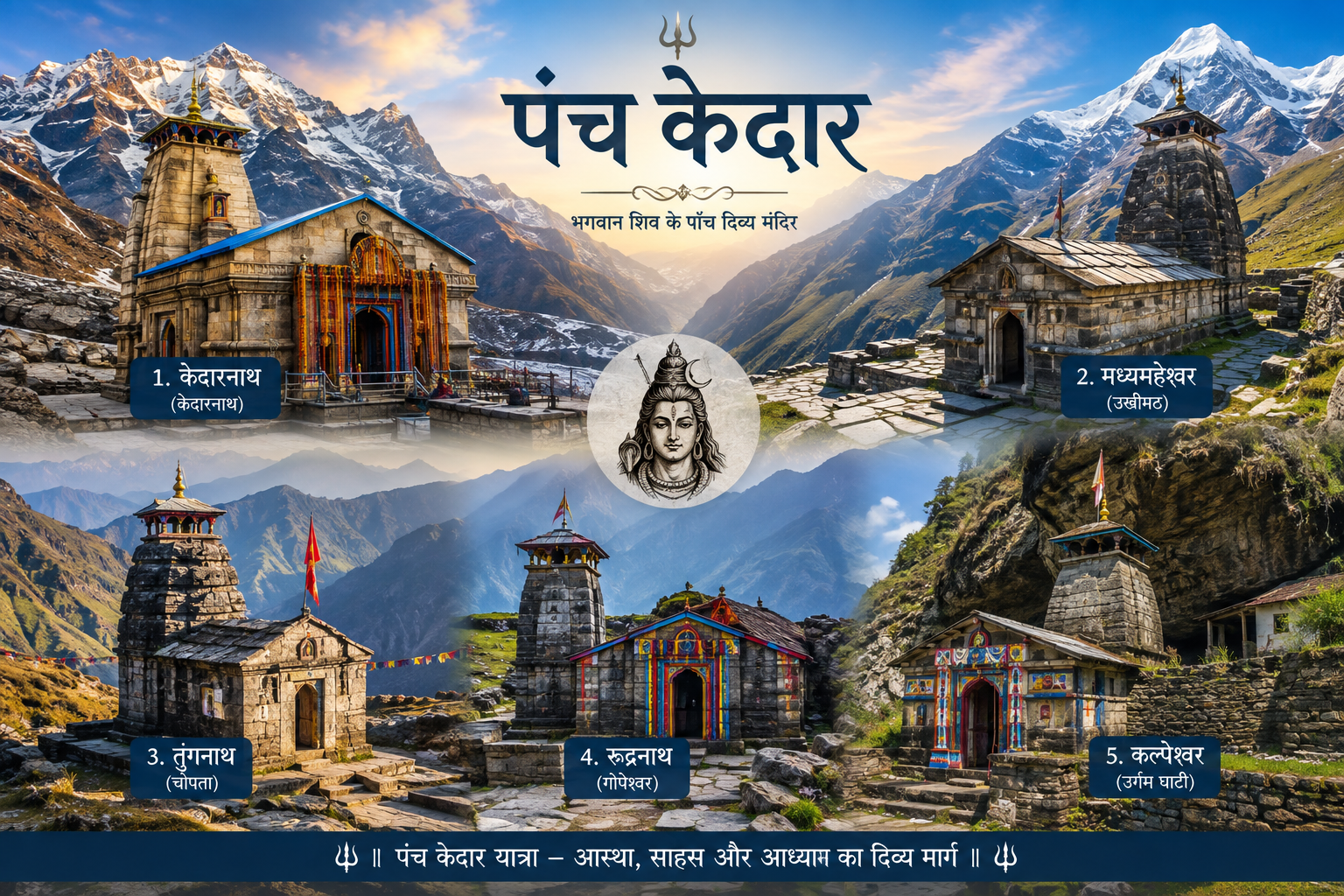
High in the Garhwal Himalayas of Uttarakhand, away from the noise of the plains, lie five sacred shrines dedicated to Lord Shiva. Together, these temples are known as Panch Kedar. They are Kedarnath, Madhyamaheshwar, Tungnath, Rudranath and Kalpeshwar.
What makes Panch Kedar different from an ordinary temple circuit is the journey itself. Some of these shrines can only be reached after long mountain walks through forests, meadows and high-altitude valleys. Others stand in quiet villages where the landscape still feels remarkably untouched.
The five temples are connected by a common Shaiva tradition and by a famous legend associated with the Pandavas. According to this tradition, different parts of Lord Shiva's manifested form are worshipped at the five locations.
What Are the Panch Kedar?
Panch Kedar refers to a group of five important Shiva temples spread across the Garhwal Himalayas of Uttarakhand. The temples are not situated together; they lie in different valleys and mountain regions, which is why completing the traditional circuit involves considerable travel as well as trekking.
Uttarakhand Tourism recognizes Panch Kedar as an important pilgrimage circuit consisting of Kedarnath and four more remote Shiva temples in the high Himalayas.
| Kedar | Associated Form of Shiva | District | Common Access Point |
|---|---|---|---|
| Kedarnath | Hump / back | Rudraprayag | Gaurikund |
| Madhyamaheshwar | Navel / middle portion | Rudraprayag | Ransi / Uniana |
| Tungnath | Arms | Rudraprayag | Chopta |
| Rudranath | Face | Chamoli | Sagar and other trekking routes |
| Kalpeshwar | Matted hair / Jata | Chamoli | Urgam Valley |
The Legend Behind Panch Kedar
The most widely known story associated with Panch Kedar comes from the Mahabharata tradition and the Pandavas.
After the Kurukshetra war, the Pandavas were troubled by remorse over the destruction caused by the battle and the deaths of their relatives and teachers. They wished to seek the blessings of Lord Shiva.
According to the traditional story, Shiva did not wish to appear before them and moved towards the Himalayas in the form of a bull. The Pandavas eventually recognized the unusual bull, and Bhima attempted to catch it.
The story says that the bull began disappearing into the ground. Different parts of Shiva's divine form are believed to have manifested at different places in the Himalayas. These places eventually became associated with the five Kedars.
The traditional association is:
- Kedarnath — the hump or back
- Madhyamaheshwar — the navel and middle portion
- Tungnath — the arms
- Rudranath — the face
- Kalpeshwar — the matted hair or Jata
Kedarnath — The Most Revered of the Five
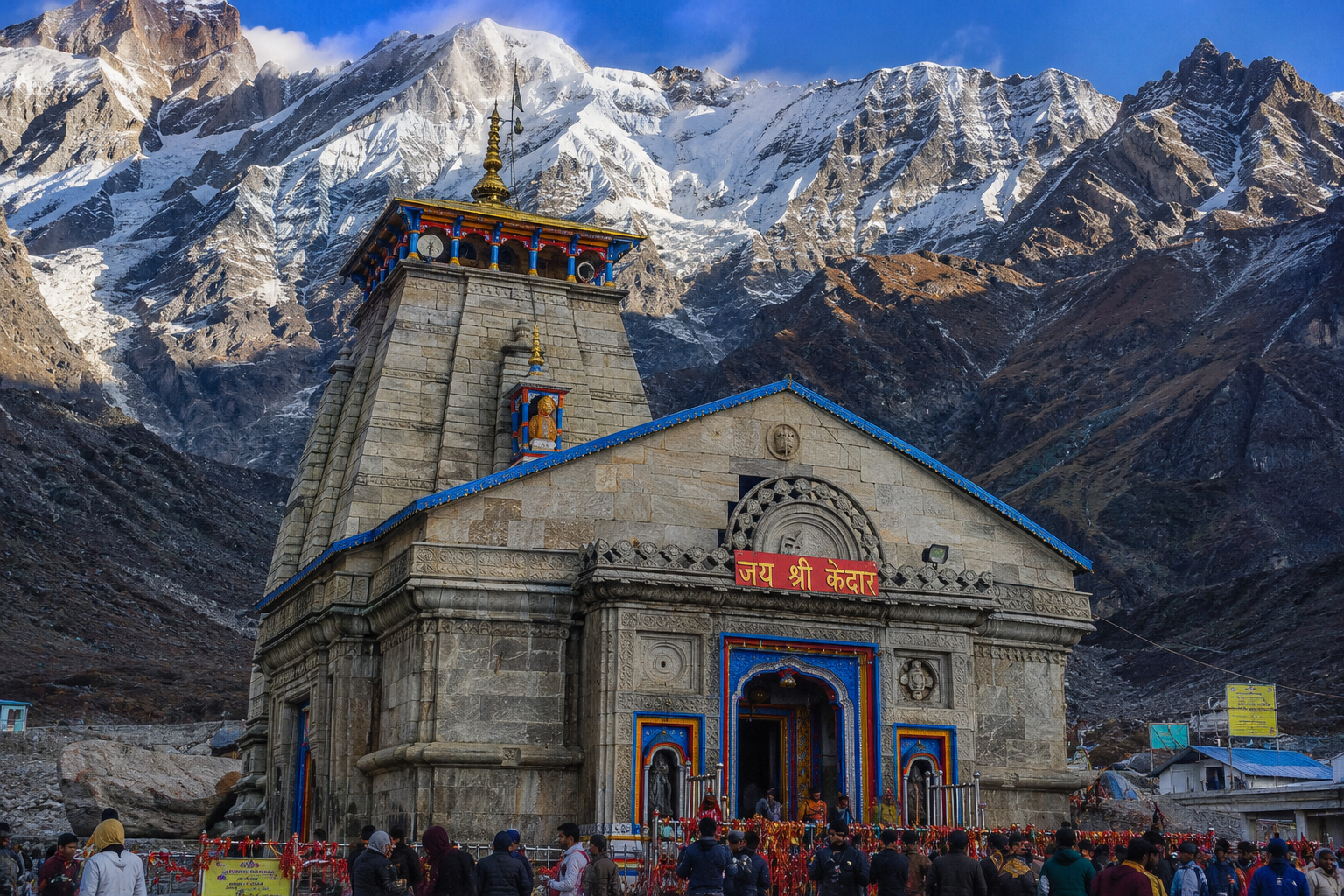
At an elevation of about 3,583 metres, Kedarnath is the best known of the Panch Kedar temples. It stands in the upper reaches of the Mandakini valley, surrounded by the dramatic mountains of the Garhwal Himalayas.
In the Panch Kedar tradition, the shrine is associated with the hump or back of Lord Shiva in his bull form. Kedarnath has another distinction that makes it especially important: it is also counted among the twelve Jyotirlingas of Lord Shiva and is one of the four Char Dham pilgrimage sites of Uttarakhand.
How to Reach Kedarnath
The road journey generally continues towards Sonprayag and then Gaurikund. From Gaurikund, pilgrims continue towards Kedarnath on foot. Uttarakhand Tourism currently describes the Gaurikund– Kedarnath journey as a substantial uphill trek, with its own official travel material giving figures around 14–17 km depending on the route and itinerary being described.
Haridwar / Rishikesh → Devprayag → Srinagar → Rudraprayag → Guptkashi → Sonprayag → Gaurikund → Kedarnath
Why Kedarnath Feels Different
The approach to Kedarnath is as much a part of the pilgrimage as the temple itself. After leaving the road behind, the landscape gradually changes into a world of steep mountain slopes, rivers, waterfalls and high Himalayan peaks.
By the time the temple comes into view, the long climb gives the pilgrimage a character that cannot be experienced from a vehicle. This combination of faith and physical effort is one of the defining qualities of Himalayan pilgrimage.
Madhyamaheshwar — The Sacred Middle of Shiva
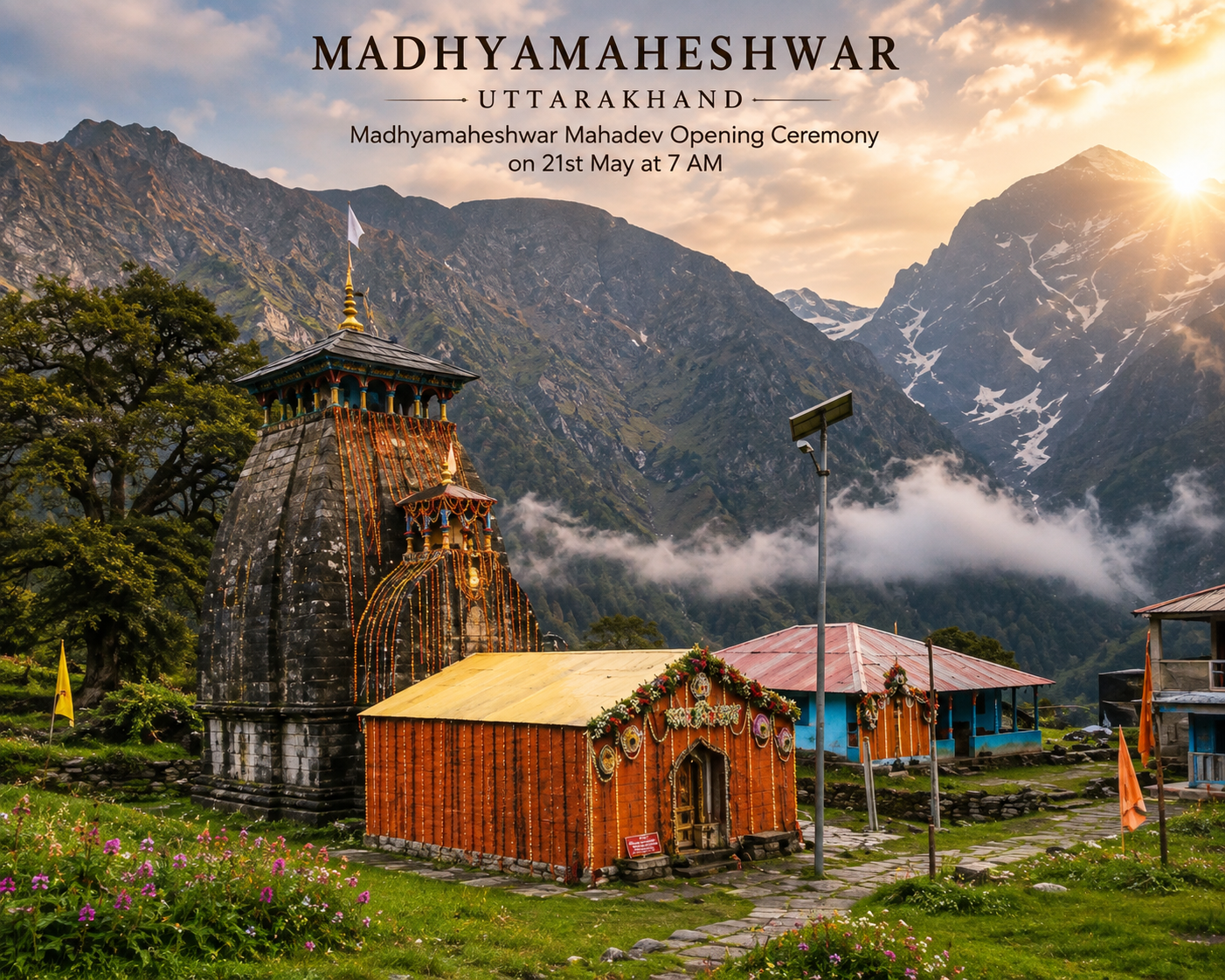
Deep in the mountains of Rudraprayag district lies Madhyamaheshwar, the second of the Panch Kedar. Here Lord Shiva is traditionally worshipped in the form of a navel-shaped manifestation.
The temple lies in a beautiful high Himalayan setting, with Chaukhamba and surrounding mountain ranges forming the backdrop. Compared with Kedarnath, the atmosphere here is quieter and the number of pilgrims is considerably smaller.
How to Reach Madhyamaheshwar
A common approach is through the Ukhimath region, continuing towards Uniana and Ransi. From the roadhead, pilgrims undertake the mountain trek towards Madhyamaheshwar.
Rishikesh → Devprayag → Rudraprayag → Ukhimath → Uniana / Ransi → Madhyamaheshwar
The exact trekking distance quoted by different travel sources can vary because the starting point and route used have changed with road development. Uttarakhand Tourism's own material describes Madhyamaheshwar as a high-altitude trekking destination and places it at the base of the Chaukhamba massif.
Buddha Madhyamaheshwar
A further walk above the main temple leads towards Buddha Madhyamaheshwar. The viewpoint is known for its wide Himalayan panorama and is one of the memorable experiences associated with the pilgrimage.
Madhyamaheshwar is particularly appealing to travellers who want the feeling of a traditional Himalayan pilgrimage without the scale and crowds of Kedarnath.
Tungnath — The Highest of the Panch Kedar
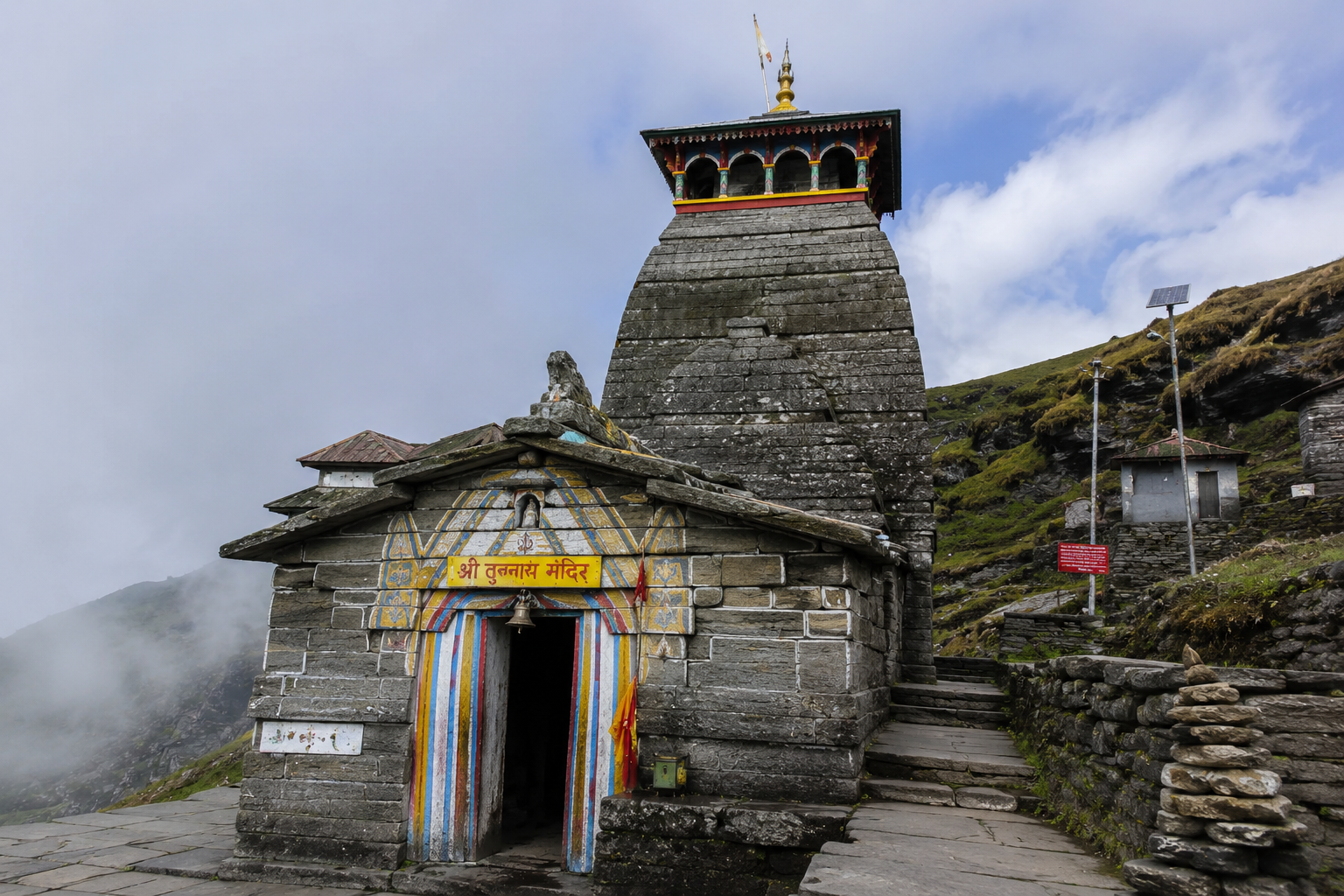
At approximately 3,680 metres, Tungnath is the highest of the five Panch Kedar temples. It is situated above Chopta and is traditionally associated with the arms of Lord Shiva.
The temple is surrounded by open mountain slopes rather than the deep forests found lower down. During the warmer months, the landscape around Chopta and Tungnath becomes one of the most attractive high-altitude walking areas in this part of Uttarakhand.
How to Reach Tungnath
Chopta is the principal starting point for the Tungnath trek. From Chopta, pilgrims follow the marked mountain path uphill to the temple.
Rishikesh → Devprayag → Rudraprayag → Ukhimath → Chopta → Tungnath
The walk is much shorter than some of the other Panch Kedar approaches, but the altitude and continuous ascent should not be underestimated.
Tungnath and Chandrashila
Chandrashila lies beyond Tungnath and is a popular additional climb for travellers. On a clear day, the summit provides broad views towards the Himalayan ranges.
Chandrashila, however, is not one of the Panch Kedar temples. It is an additional mountain excursion undertaken by many visitors who come to Tungnath.
Uttarakhand Tourism identifies Tungnath as a major Panch Kedar destination at around 3,680 metres and highlights trekking and the Chopta–Chandrashila landscape as important attractions.
Rudranath — The Face of Lord Shiva
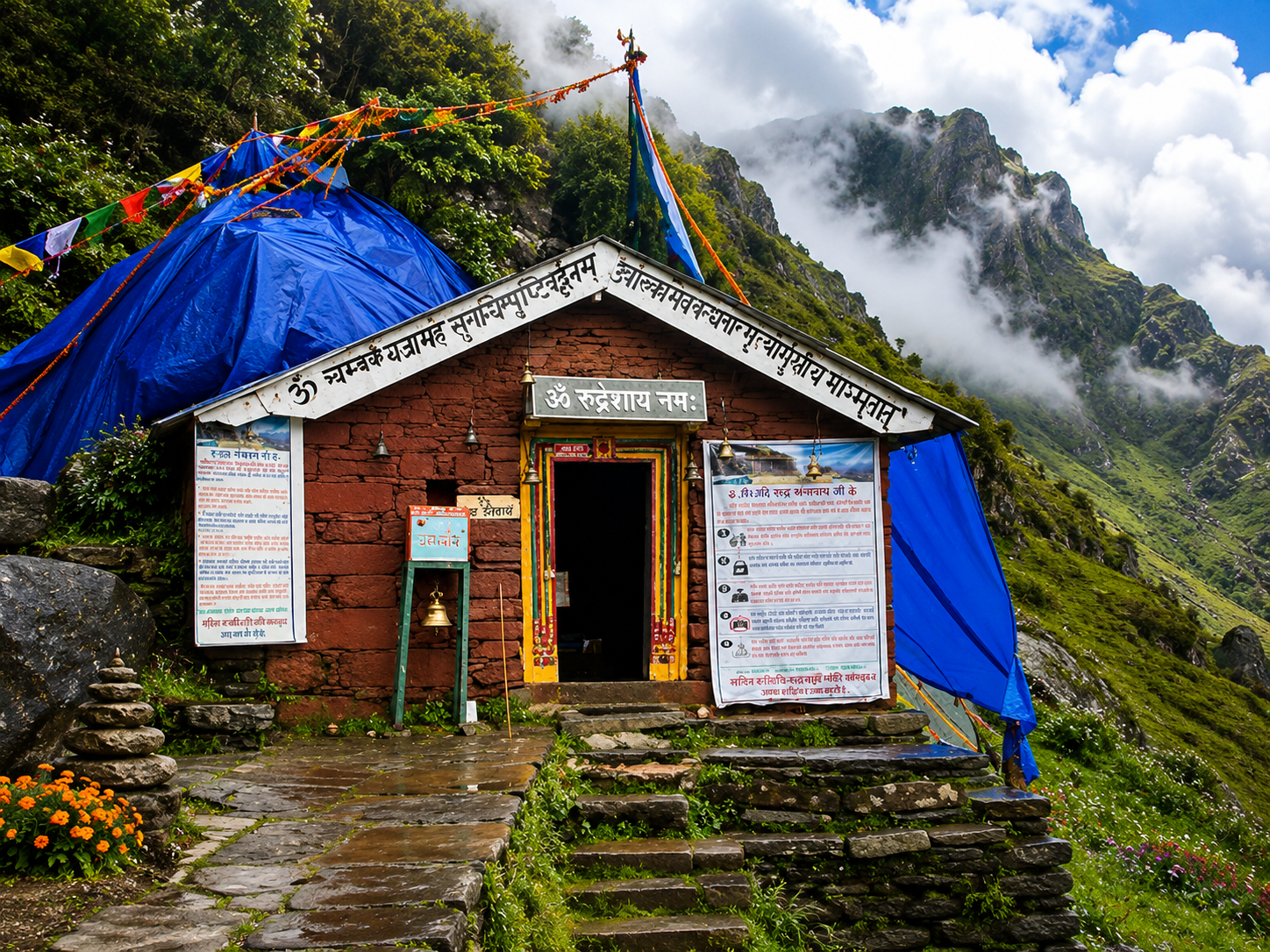
Of the five shrines, Rudranath perhaps gives the strongest feeling of wilderness. Located in the Chamoli region, the temple is traditionally associated with the face of Lord Shiva.
Unlike the broad pilgrimage infrastructure around Kedarnath, the approach to Rudranath takes travellers deep into Himalayan terrain. Forests, alpine meadows, streams and mountain ridges form much of the journey.
How to Reach Rudranath
Several trekking approaches are used for Rudranath. The Sagar village route is one of the commonly described approaches, while other routes connect from different villages and valleys.
Rishikesh → Devprayag → Rudraprayag → Gopeshwar → Sagar → Rudranath
The route is considerably more demanding than a short temple walk. Distance figures can differ depending on the approach, and conditions on mountain trails can change with weather.
Why Rudranath Is Considered Special
Rudranath is not simply a temple at the end of a trek. The entire landscape forms part of the experience. The feeling of walking through remote meadows and forests before arriving at the shrine is one reason this temple occupies such an important place in the Panch Kedar tradition.
Uttarakhand Tourism also identifies Rudranath as a remote high-Himalayan temple and includes eco-friendly trekking and camping among the attractions and proposed tourism facilities for the circuit.
Kalpeshwar — The Temple of Shiva's Jata
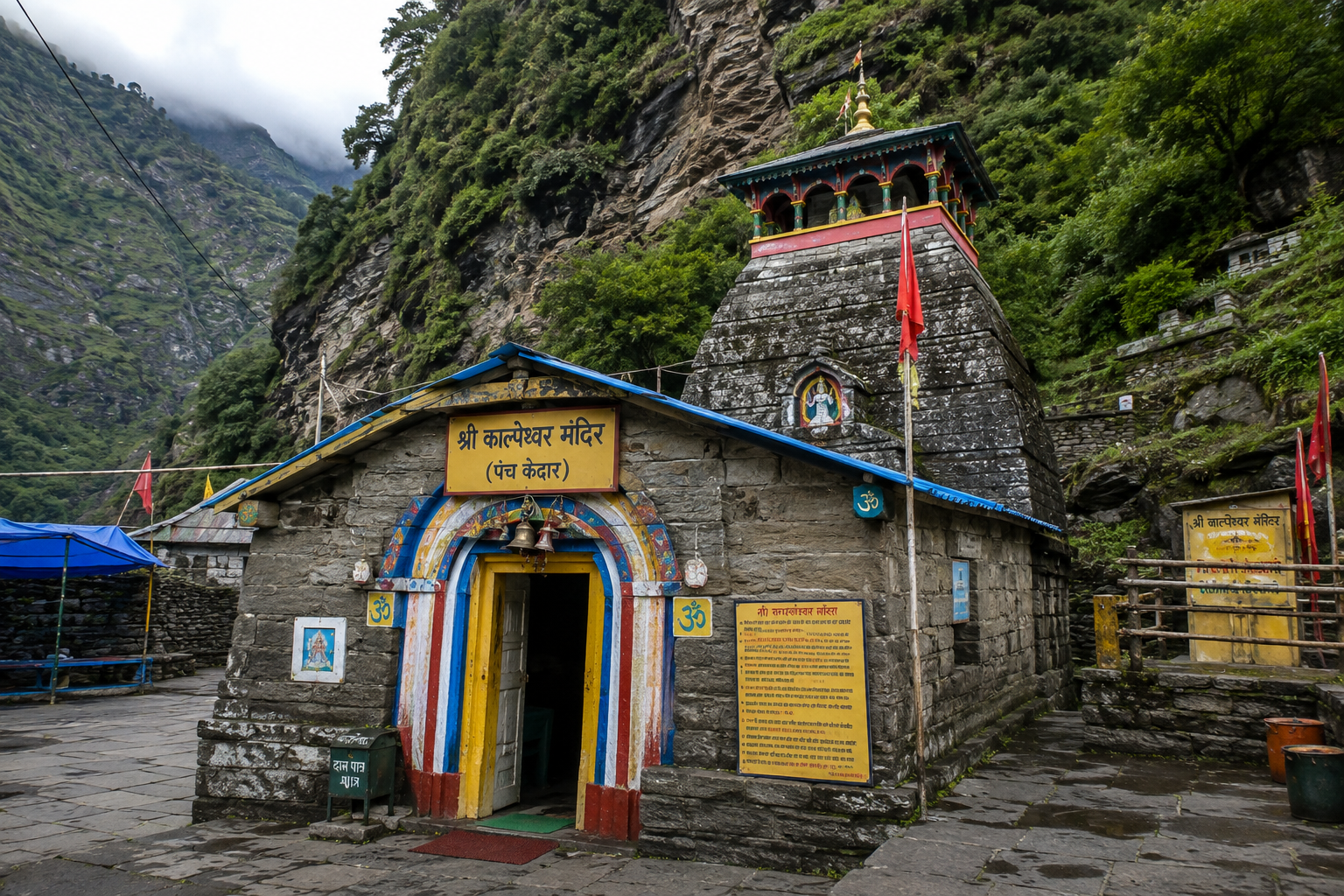
The fifth and final shrine of Panch Kedar is Kalpeshwar, located in the beautiful Urgam Valley of Chamoli district.
Here Lord Shiva is traditionally worshipped in the form of his matted hair, or Jata. The shrine has a distinct character because it is associated with a natural rock and cave-like setting rather than the large temple complex familiar from Kedarnath.
How to Reach Kalpeshwar
The journey generally proceeds towards the Helang and Urgam Valley region. From the road-accessible area, visitors continue towards the temple on foot.
Rishikesh → Devprayag → Rudraprayag → Karnaprayag → Chamoli → Helang → Urgam Valley → Kalpeshwar
Compared with the long approaches to Madhyamaheshwar and Rudranath, the final walk to Kalpeshwar is relatively short. This makes it one of the more accessible shrines within the Panch Kedar circuit, although the mountain journey to the Urgam region still requires planning.
Uttarakhand Tourism describes Kalpeshwar as a shrine in the Urgam Valley where Shiva is worshipped in his matted hair and lists it as part of the Panch Kedar circuit.
The Traditional Order of Panch Kedar
The traditional sequence generally associated with the Panch Kedar pilgrimage is:
| Order | Temple | Associated Form |
|---|---|---|
| 1 | Kedarnath | Hump / Back |
| 2 | Madhyamaheshwar | Navel / Middle |
| 3 | Tungnath | Arms |
| 4 | Rudranath | Face |
| 5 | Kalpeshwar | Jata / Matted Hair |
This is the traditional religious sequence. A practical itinerary does not necessarily have to follow exactly the same order, because modern road access, weather, trekking conditions and available accommodation can affect how pilgrims plan the journey.
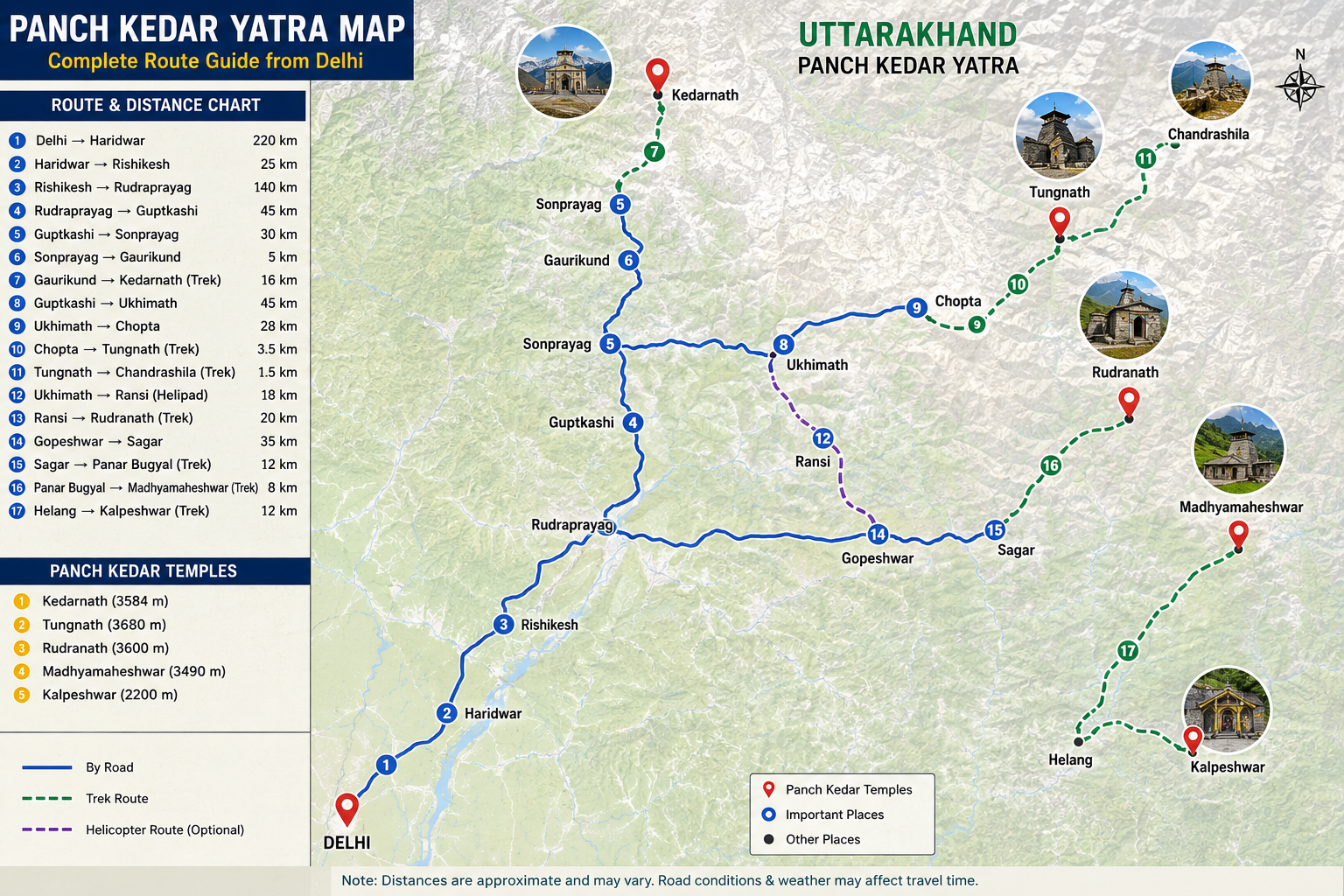
Panch Kedar Route: How the Journey Connects
One important thing to understand before planning Panch Kedar is that this is not one continuous trek. The five temples are located in different parts of the Garhwal Himalayas. The journey therefore combines road travel, village roads and several separate trekking sections.
For Kedarnath
The principal road approach runs towards Sonprayag and Gaurikund, followed by the trek to Kedarnath.
For Madhyamaheshwar
The route generally moves through Ukhimath towards Uniana and Ransi, followed by the mountain trek to the temple.
For Tungnath
Chopta is the principal starting point for the Tungnath trek.
For Rudranath
Gopeshwar and Sagar are commonly used in routes towards Rudranath, although more than one trekking approach exists.
For Kalpeshwar
The journey moves towards Helang and the Urgam Valley before the final walk to the shrine.
Best Time to Visit Panch Kedar
The best time depends on which of the five temples you are visiting. The higher shrines experience heavy winter snowfall, and seasonal temple opening and closing arrangements are therefore an important part of Himalayan pilgrimage planning.
May to June
This is one of the main pilgrimage periods. Temperatures are generally more suitable for trekking, although popular routes can become busy.
July to August
The monsoon brings lush greenery but also increases the possibility of landslides, road disruptions and slippery trekking trails. Long Himalayan treks require particular caution during this period.
September to October
The post-monsoon period can offer clearer mountain views and pleasant trekking conditions. However, temperatures begin to fall quickly at higher elevations as winter approaches.
Exact temple opening dates and access arrangements should always be checked for the particular year of travel rather than copied from an older itinerary.
Which Panch Kedar Trek Is the Most Difficult?
There is no single scientific difficulty ranking because a trek's challenge depends on elevation gain, weather, trail conditions, distance, fitness and acclimatization. Still, in practical terms, the five journeys differ considerably.
| Kedar | General Character | Main Challenge |
|---|---|---|
| Kedarnath | Long pilgrimage trek | Distance, elevation and crowds |
| Madhyamaheshwar | Long mountain trek | Continuous walking and ascent |
| Tungnath | Shorter but high-altitude trek | Steady uphill climb and altitude |
| Rudranath | Remote Himalayan trek | Long approaches and limited facilities |
| Kalpeshwar | Relatively short final walk | Mountain road access |
Among experienced pilgrims and trekkers, Rudranath is generally regarded as one of the more demanding Panch Kedar journeys because of its remoteness and long trekking approaches.
History and Antiquity of the Panch Kedar Temples
The history of Panch Kedar cannot be understood only through the legends associated with the temples. The shrines have developed within a living Himalayan religious tradition in which pilgrimage, local communities, priests and seasonal worship have all played an important role.
The Pandavas are traditionally credited with establishing or discovering these sacred locations, and some traditions also connect the temples with Adi Shankaracharya. These beliefs are deeply rooted in the religious culture surrounding the shrines.
At the same time, it is important to distinguish between religious tradition and archaeological certainty. The surviving structures cannot simply be assigned a single construction date based only on the Pandava or Shankaracharya traditions.
What can be said with confidence is that these temples form part of a long-standing Shaiva pilgrimage landscape in the Garhwal Himalayas. Their importance has survived through generations despite the difficult geography and harsh Himalayan winters.
What Happens to Panch Kedar in Winter?
Winter completely changes the character of the high Himalayas. Heavy snowfall can make the upper temples inaccessible, and the traditional worship of the deity is therefore continued at designated winter seats in lower and more accessible locations.
This seasonal movement is an important part of Uttarakhand's Himalayan temple tradition. The closing of an upper shrine for winter does not mean that worship of the deity stops; rather, the ritual tradition continues at its winter seat until the seasonal return.
How to Prepare for a Panch Kedar Yatra
Panch Kedar should not be approached like a normal sightseeing trip. Even the comparatively shorter walks take place in mountainous terrain, while some routes involve long hours of trekking.
- Begin regular walking and stair training several weeks before the journey.
- Carry proper trekking shoes with good grip.
- Pack warm layers even during the warmer months.
- Carry rain protection because Himalayan weather can change quickly.
- Keep sufficient water and essential personal medicines.
- Do not ignore symptoms caused by altitude or exhaustion.
- Keep some food and basic supplies for longer, remote treks.
- Check current road and trekking conditions before departure.
- For remote routes such as Rudranath, consider travelling with someone familiar with the local trail.
The Spiritual Meaning of Panch Kedar
There is something distinctive about a pilgrimage where the temple cannot simply be reached by parking a vehicle outside its entrance. In Panch Kedar, the journey itself demands time, patience and effort.
The mountains gradually replace the sounds of towns. Roads become trails. Villages become smaller. Forests become deeper. The familiar conveniences of everyday life slowly disappear.
That physical separation from ordinary life is part of what gives these temples their atmosphere.
Kedarnath carries the grandeur of a major national pilgrimage. Madhyamaheshwar offers quiet mountain solitude. Tungnath combines worship with an extraordinary high-altitude landscape. Rudranath takes the pilgrim deep into the wilderness, while Kalpeshwar offers a more intimate shrine within the Urgam Valley.
Panch Kedar and Char Dham: What Is the Difference?
Panch Kedar and Uttarakhand's Char Dham are two different pilgrimage traditions, although Kedarnath is common to both.
| Panch Kedar | Uttarakhand Char Dham |
|---|---|
| Kedarnath | Kedarnath |
| Madhyamaheshwar | Badrinath |
| Tungnath | Gangotri |
| Rudranath | Yamunotri |
| Kalpeshwar | — |
Panch Kedar is specifically a Shaiva pilgrimage circuit centred on five sacred manifestations of Lord Shiva, whereas Uttarakhand's Char Dham consists of four major pilgrimage centres associated with different Hindu traditions.
Frequently Asked Questions About Panch Kedar
How many temples are there in Panch Kedar?
There are five temples: Kedarnath, Madhyamaheshwar, Tungnath, Rudranath and Kalpeshwar.
Which is the first Kedar?
Kedarnath is traditionally regarded as the first of the Panch Kedar.
Which is the highest Panch Kedar temple?
Tungnath, at approximately 3,680 metres above sea level, is the highest of the five Panch Kedar temples.
Which Panch Kedar trek is the hardest?
Rudranath is generally considered one of the most demanding because of its remote location and long trekking approaches.
Is Panch Kedar one continuous trek?
No. The five temples are located in different parts of the Garhwal Himalayas. The complete pilgrimage combines road travel with several separate trekking sections.
Can Panch Kedar be completed in one trip?
Yes, it can be planned as one extended pilgrimage, but the required time depends on the route, weather, road conditions, trekking speed and time available for each temple.
Is Panch Kedar suitable for elderly pilgrims?
It depends greatly on the individual and the temple. The long and high-altitude approaches to some shrines require considerably more physical effort than others. Medical fitness, acclimatization and route difficulty should be considered before planning the journey.
What is the best month for Panch Kedar?
The main pilgrimage season is generally during the warmer months and the post-monsoon period, but exact opening dates and route conditions vary by temple and year. Current official information should always be checked before travelling.
Panch Kedar: A Journey Through the Abode of Shiva
Panch Kedar is much more than a list of five Shiva temples. It is a journey through some of the most remote and beautiful landscapes of the Garhwal Himalayas.
At Kedarnath, the pilgrim encounters the grandeur of one of India's most revered Shiva shrines. At Madhyamaheshwar, the mountains feel quieter and more intimate. Tungnath rises into the high Himalayas. Rudranath takes the journey deeper into the wilderness, and Kalpeshwar brings the traditional circuit to its final shrine in the Urgam Valley.
The ancient story of Shiva and the Pandavas connects all five places into one sacred tradition, while the mountains, villages, forests and trails give each temple its own character.
For a pilgrim, the greatest lesson of Panch Kedar may not be found only inside the sanctum. It may be found on the path — in the patience required to climb, the silence of the mountains, and the feeling of finally reaching a shrine after a long journey.

Comments