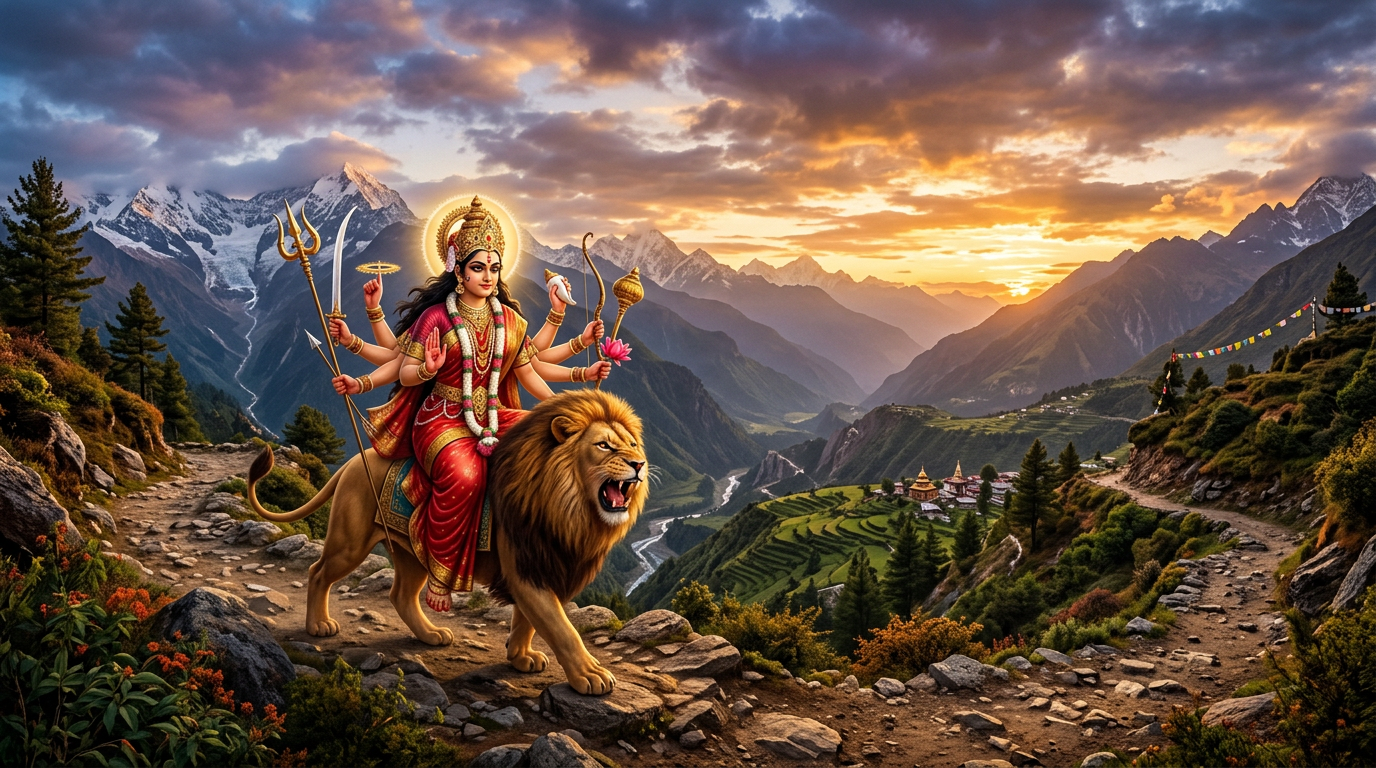
Durga Puja 2026 will begin on Sunday, October 11 with Ghatasthapana (Pratipada) and conclude on Tuesday, October 21 with Vijayadashami. Learn about the Goddess worshipped on each of the nine days, their mantras, Puja Vidhi, and all important dates in one place.
Last updated: August 25, 2026 · Dates verified according to the Panchang
Ghatasthapana
October 11, 2026
Maha Ashtami
October 18, 2026
Maha Navami
October 20, 2026
Vijayadashami
October 21, 2026
Time remaining until Ghatasthapana: Calculating…
Durga Puja 2026 Date
Important Dates — Durga Puja 2026 Full Calendar
Complete date list from Pratipada to Vijayadashami, including the date and day of the week.
Durga Puja / Sharadiya Navratri 2026 — Date List
Tithi
Date
Day
Occasion
Mahalaya Amavasya
October 10, 2026
Saturday
Mahalaya
Pratipada
October 11, 2026
Sunday
Ghatasthapana
Dwitiya
October 12, 2026
Monday
Goddess Brahmacharini Puja
Tritiya
October 13, 2026
Tuesday
Goddess Chandraghanta Puja
Chaturthi
October 14, 2026
Wednesday
Goddess Kushmanda Puja
Panchami
October 15, 2026
Thursday
Goddess Skandamata Puja
Shashthi
October 16, 2026
Friday
Goddess Katyayani / Bodhan
Saptami
October 17, 2026
Saturday
Goddess Kalaratri Puja
Ashtami
October 18, 2026
Sunday
Maha Ashtami / Sandhi Puja
Navami
October 20, 2026
Monday
Maha Navami / Kanya Puja
Dashami
October 21, 2026
Tuesday
Vijayadashami / Idol Immersion
Navdurga · Nine Forms of the Goddess
The Nine Days of Navratri — Nine Forms of the Goddess and Their Mantras
The stories, mantras, and significance of worshipping the nine forms of Goddess Durga — according to each day.
Day 1
Pratipada · October 11, 2026, Sunday
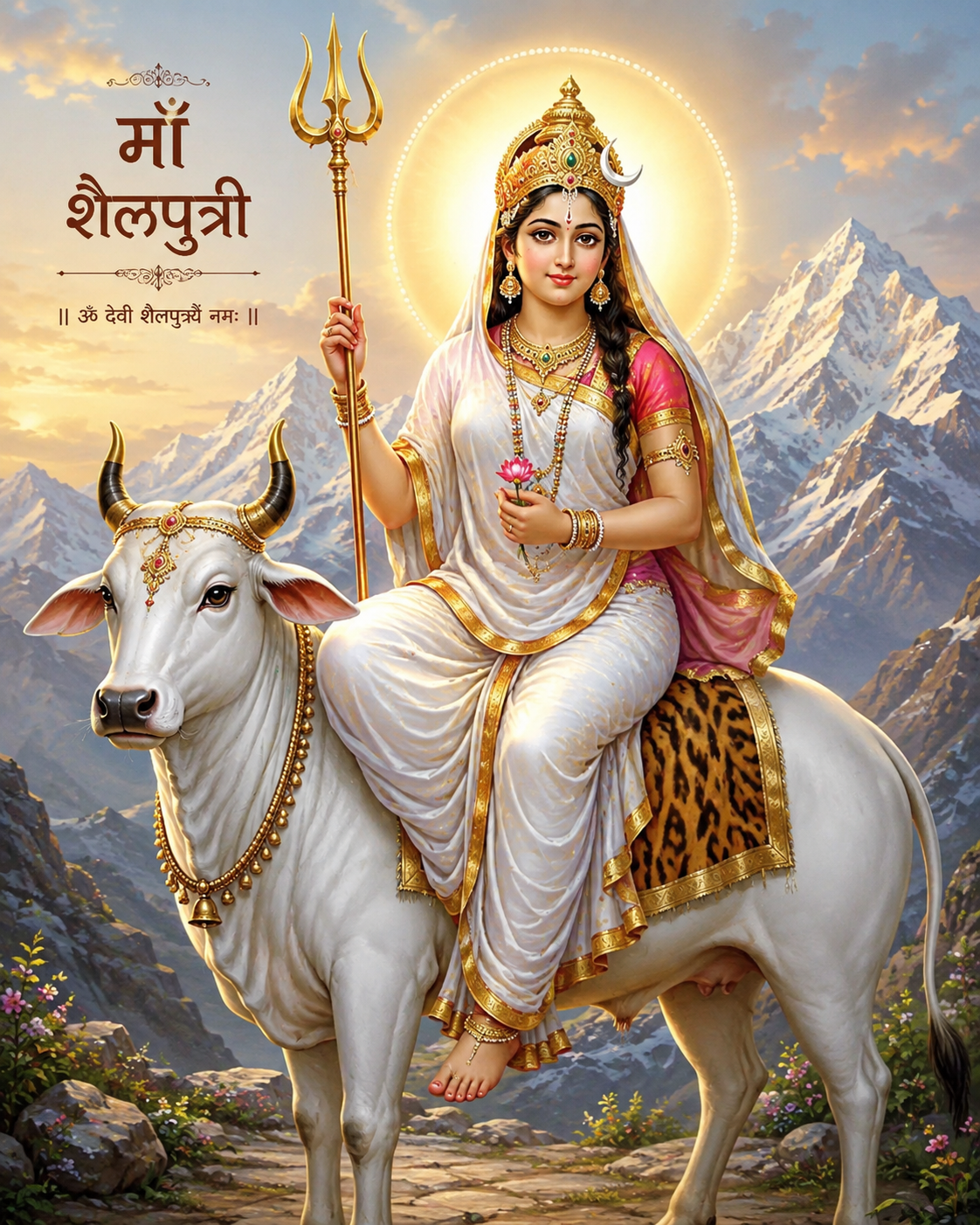
Goddess Shailaputri
प्रथमं शैलपुत्री इति
On the first day of Navratri, Goddess Shailaputri, the daughter of King Himalaya, is worshipped. Seated on a bull and holding a trident in her right hand and a lotus in her left, she represents strength and stability. Ghatasthapana is performed on this day and the Sankalpa for the Navratri fast is taken.
Significance: This mantra is traditionally chanted for awakening the Muladhara Chakra and seeking fulfillment of one's wishes.
Day 2
Dwitiya · October 12, 2026, Monday
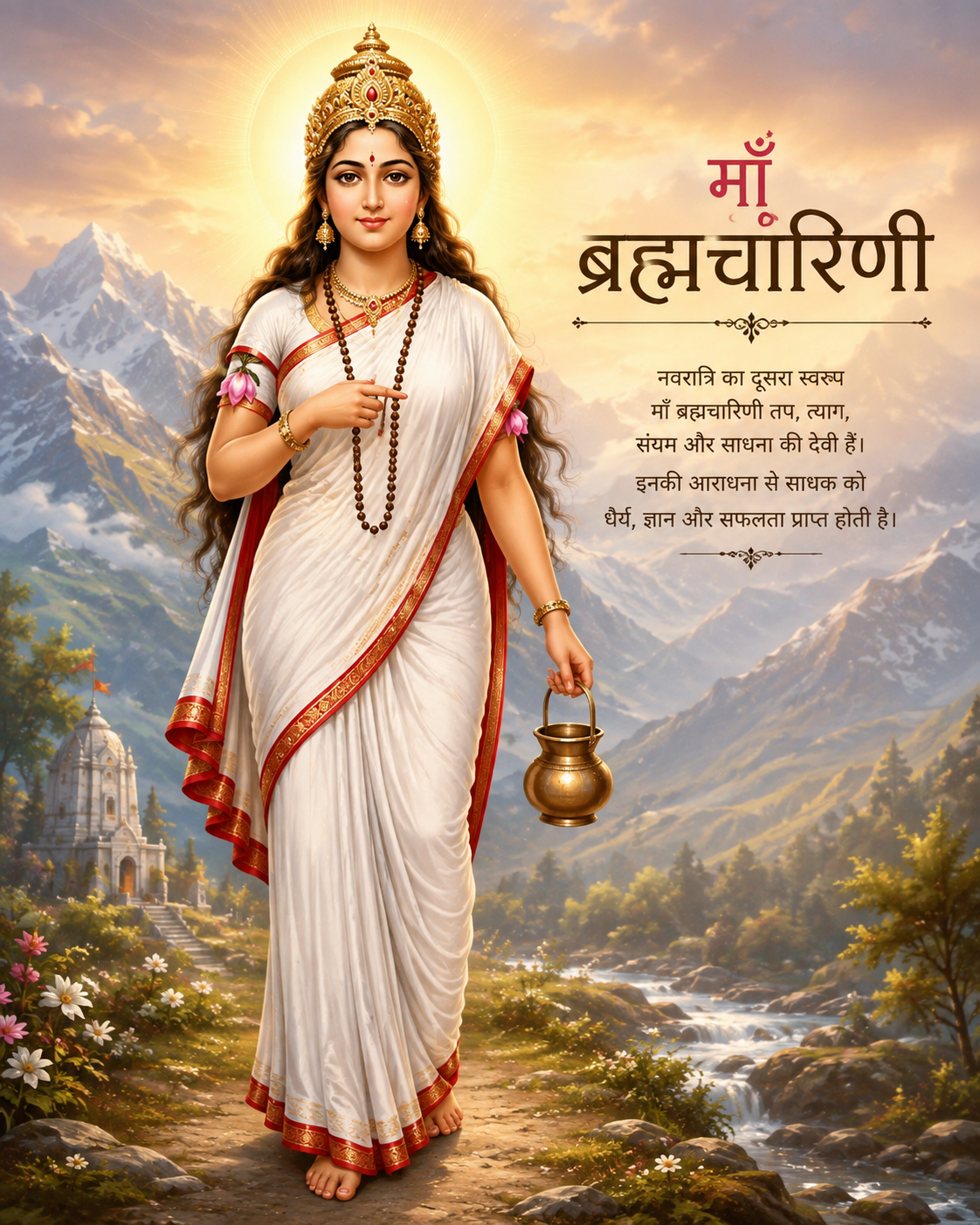
Goddess Brahmacharini
तपश्चारिणी देवी
On the second day, Goddess Brahmacharini is worshipped, representing the Goddess who undertook intense austerities. She holds a rosary in one hand and a Kamandalu in the other. This form symbolizes discipline, sacrifice, and spiritual austerity, which are traditionally believed to give the devotee patience and inner strength.
Dhyana Mantra
दधाना कर पद्माभ्यामक्षमालाकमण्डलू। देवी प्रसीदतु मयि ब्रह्मचारिण्यनुत्तमा॥
Significance: This mantra is traditionally chanted for balancing the Svadhishthana Chakra and strengthening self-discipline.
Day 3
Tritiya · October 13, 2026, Tuesday
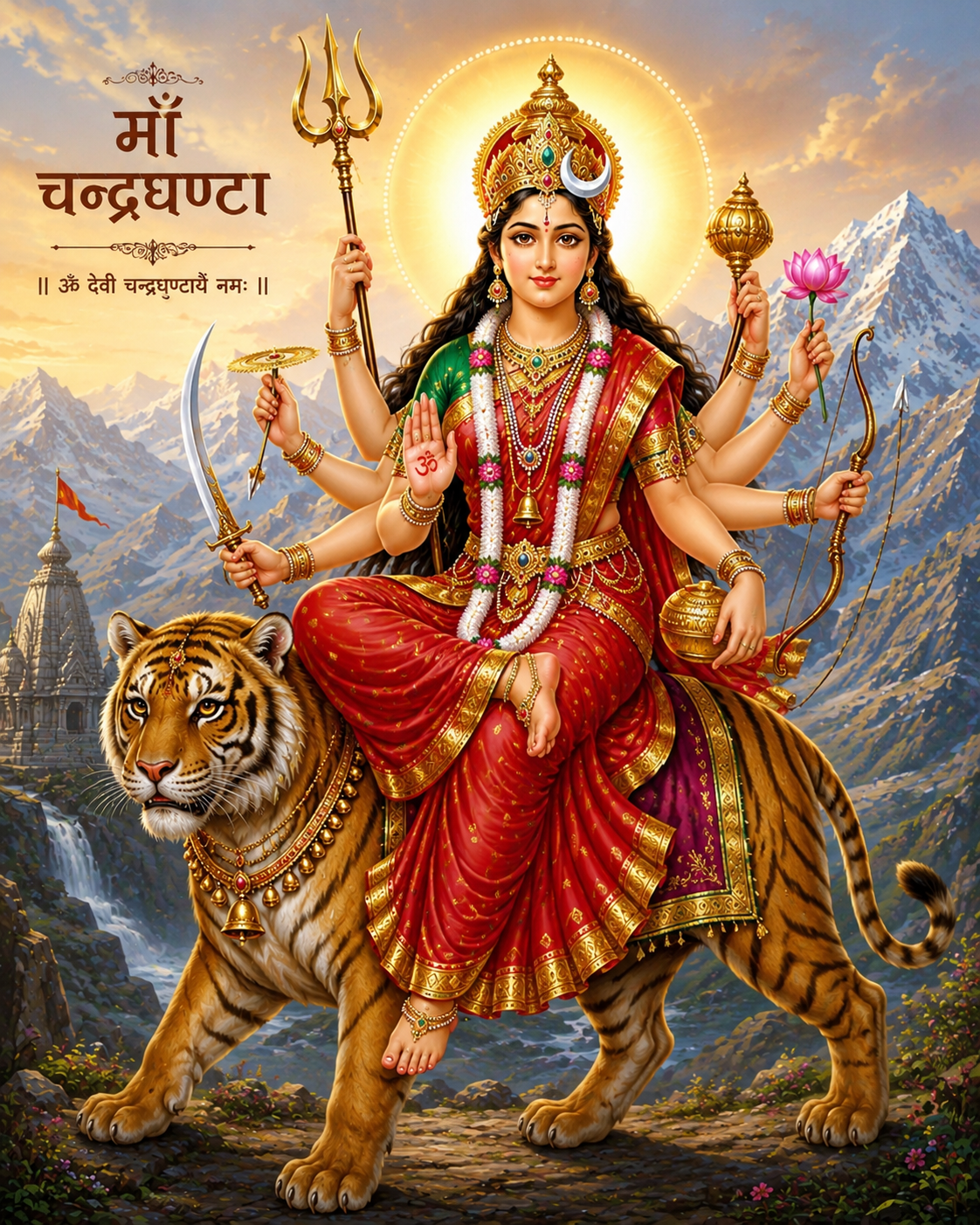
Goddess Chandraghanta
घण्टानिनादाभिनन्दिनी
On the third day, Goddess Chandraghanta is worshipped, with a crescent moon shaped like a bell adorning her forehead. Riding a lion, she represents both courage and serenity. Her worship is traditionally believed to dispel fear and make the devotee fearless.
Significance: This mantra is traditionally considered beneficial for awakening the Manipura Chakra and cultivating mental peace.
Day 4
Chaturthi · October 14, 2026, Wednesday
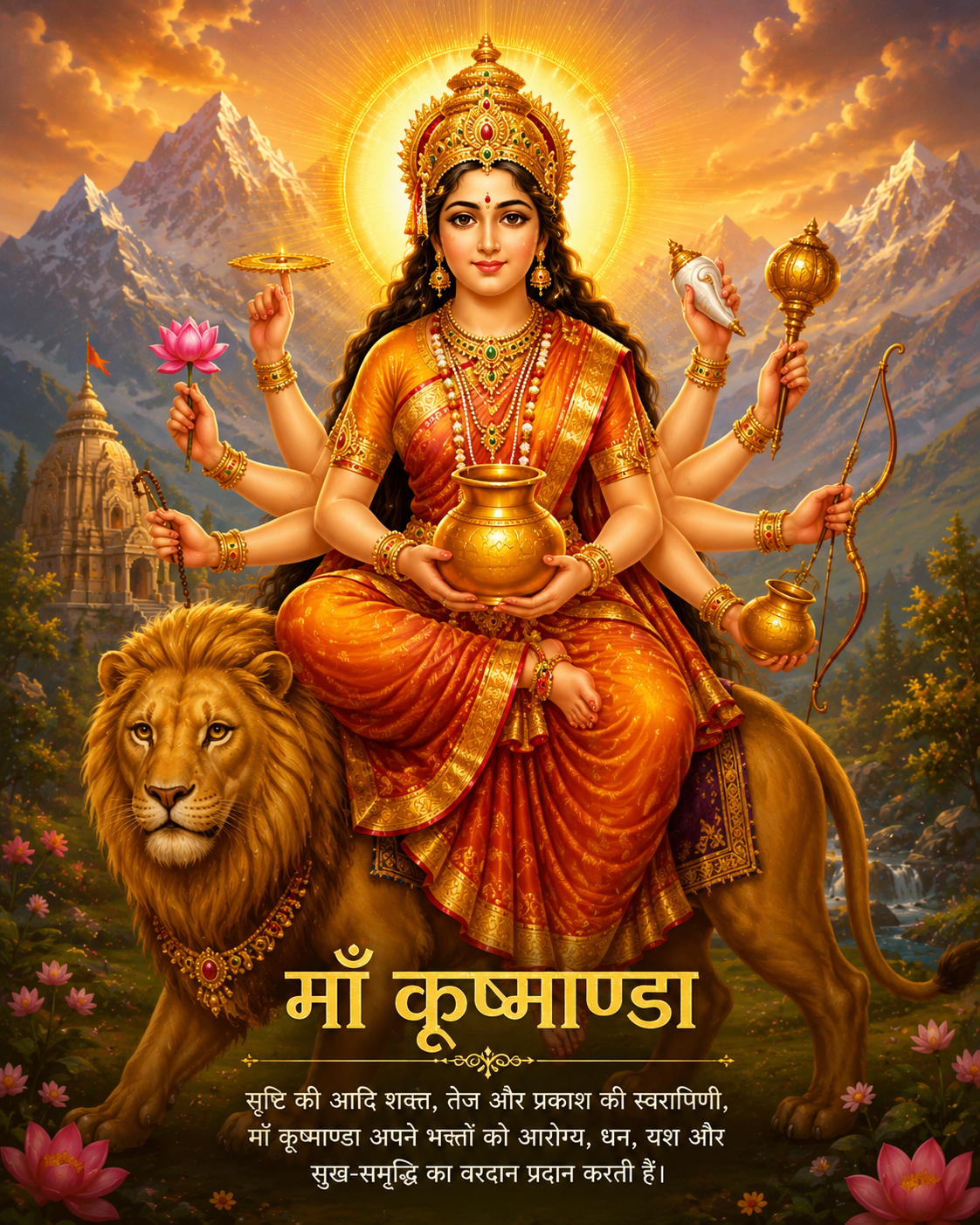
Goddess Kushmanda
Primordial Power of Creation
On the fourth day, Goddess Kushmanda is worshipped. According to tradition, she is believed to have created the universe with her gentle smile. In her eight-armed form, she is associated with the power to reside in the realm of the Sun and is depicted riding a lion.
Significance: This mantra is traditionally chanted for awakening the Anahata Chakra and seeking relief from illness.
Day 5
Panchami · October 15, 2026, Thursday
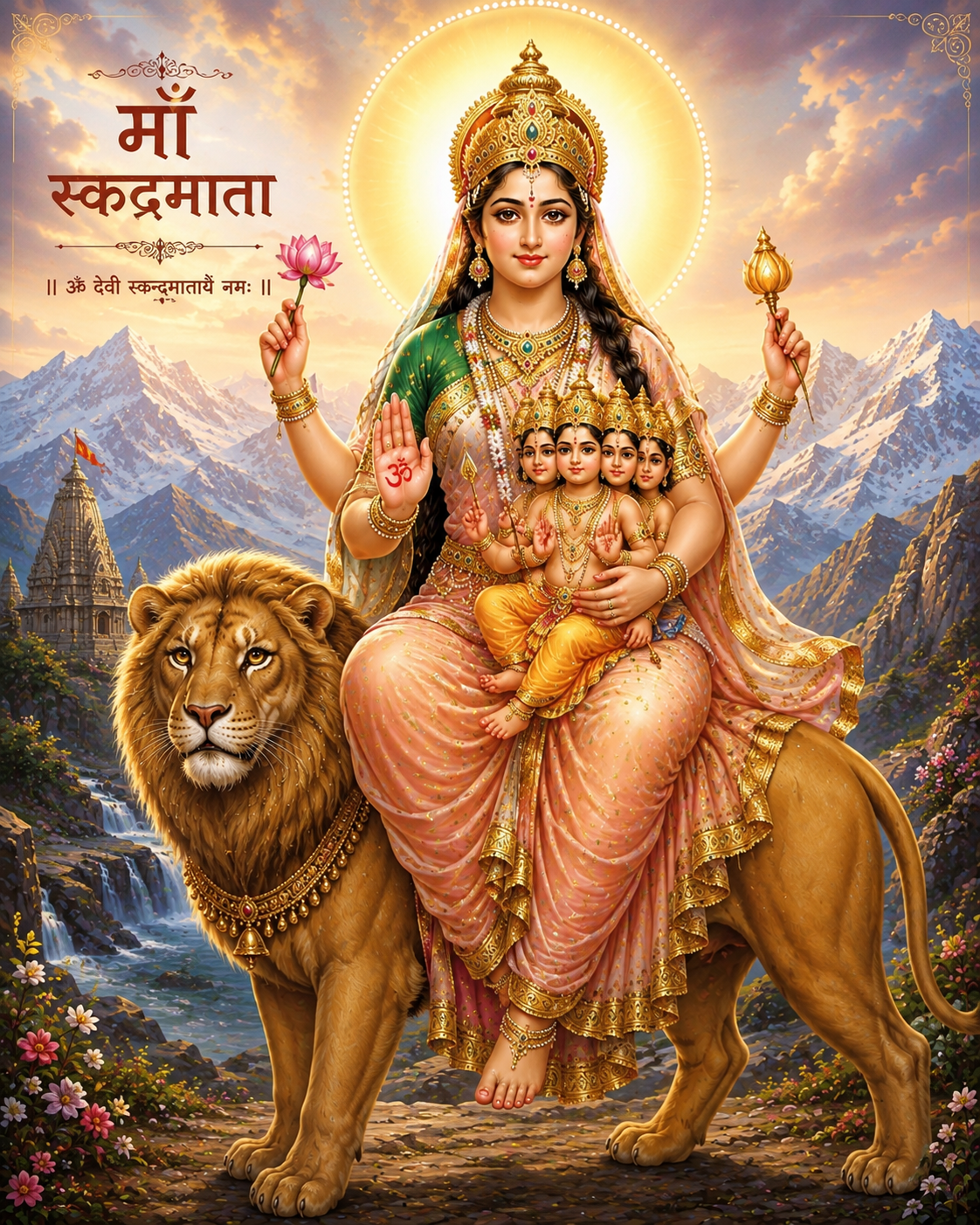
Goddess Skandamata
Mother of Skanda
On the fifth day, the Goddess is worshipped as the mother of Lord Kartikeya (Skanda). Depicted with four arms and holding her son Skanda in her lap, she is seated on a lotus and is therefore also known as Padmasana.
Dhyana Mantra
सिंहासनगता नित्यं पद्माश्रितकरद्वया। शुभदास्तु सदा देवी स्कन्दमाता यशस्विनी॥
Significance: Worship is traditionally performed for awakening the Vishuddha Chakra and seeking the blessings of children and family happiness and harmony.
Day 6
Shashthi · October 16, 2026, Friday
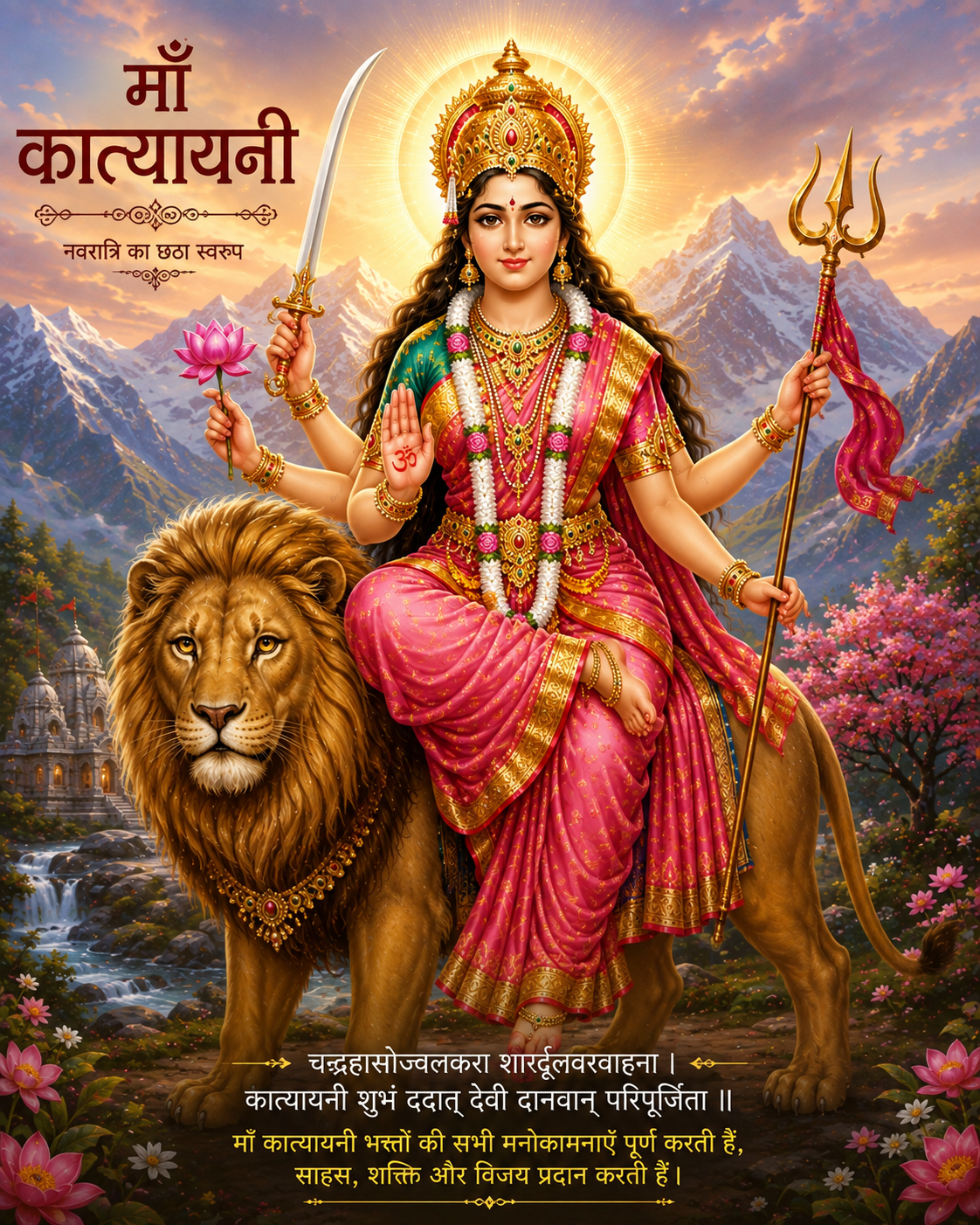
Goddess Katyayani
वीर्यशालिनी देवी
On the sixth day, Goddess Katyayani is worshipped. According to tradition, she was born in the ashram of Sage Katyayana. This form is regarded as one of the fierce and courageous forms of Goddess Durga. In Bengal, Devi's Bodhan and invocation are performed on this day, formally beginning the Durga Puja festivities.
🌿 Belnoti (Bel Nimantran) Tradition of Mithila
In the Mithila region, a special tradition associated with Durga Puja is observed on Shashthi, known as "Belnoti" or "Bel Nimantran." On this occasion, the Bel tree is ritually invited according to traditional customs. According to local belief and tradition, the fruit of the invited Bel tree is later used to create the eye representation in the idol of Goddess Durga.
On the night of Belnoti, devotees traditionally spend the night in vigil beneath the Bel tree. This ritual is locally known as Belnoti, Bel Nimantran, or Bel Nyot. The tradition reflects the beautiful integration of nature, Goddess worship, and local customs in the Durga Puja traditions of Mithila.
Significance: This mantra is traditionally chanted for awakening the Ajna Chakra and seeking relief from obstacles related to marriage.
Day 7
Saptami · October 17, 2026, Saturday
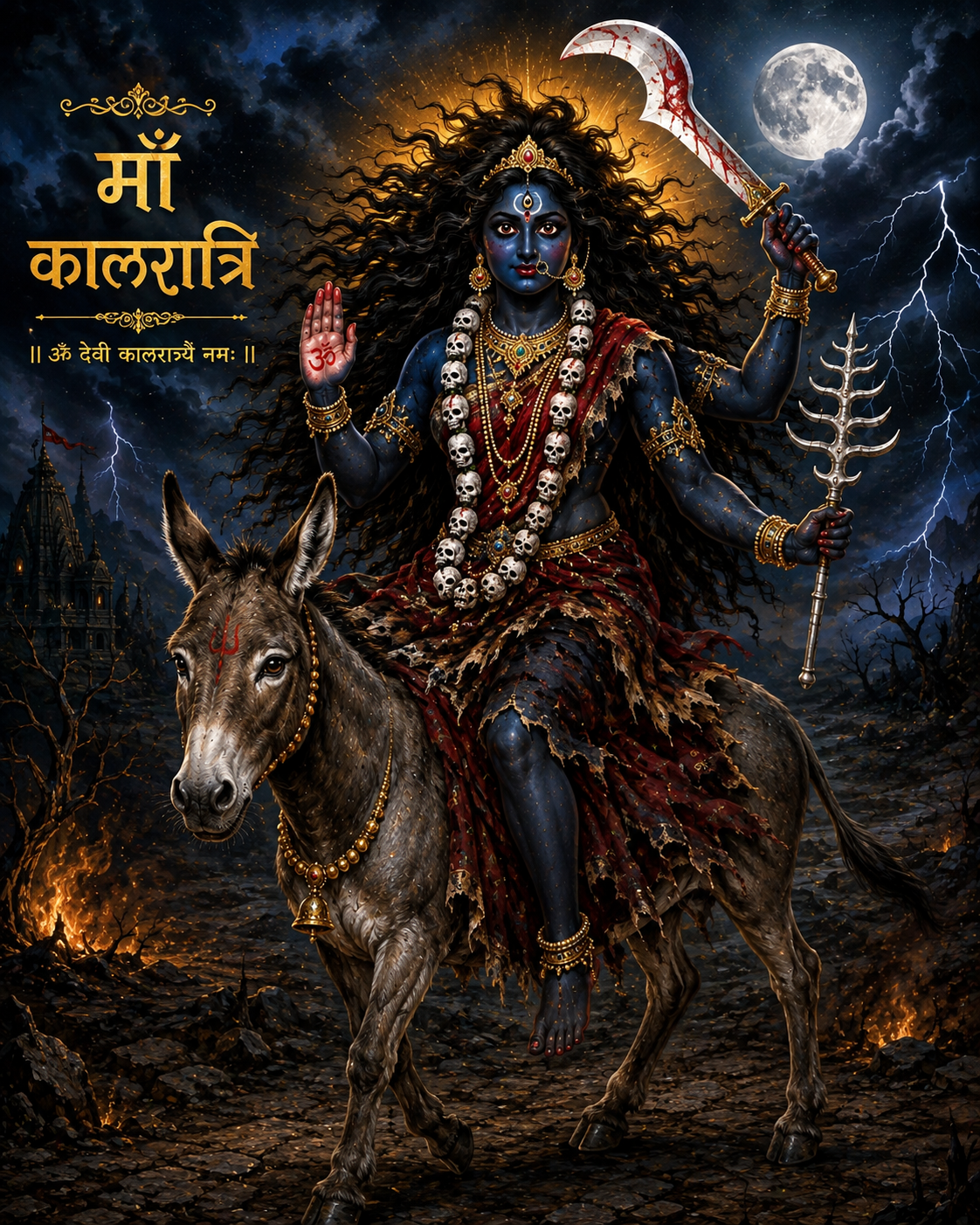
Goddess Kalaratri
शुभंकरी देवी
On the seventh day, Goddess Kalaratri is worshipped. Although this form of the Goddess appears fierce, she is traditionally regarded as auspicious in her blessings and is therefore also called Shubhankari. With a dark complexion, fiery breath, and a donkey as her mount, she is believed to destroy fear, negativity, and ignorance.
🌺 The Main Festive Atmosphere of Durga Puja Begins on Saptami
The atmosphere of Durga Puja becomes especially vibrant on Saptami morning. On this day, the curtain is opened for devotees to have Darshan of the Goddess, marking the beginning of the main festive celebrations. From this day onward, fairs, cultural activities, and the main festive atmosphere around Puja pandals become increasingly active.
In many places, the tradition of Kumari and Batuk Bhojan also begins from Saptami. Young girls and boys are respectfully treated as manifestations of the Goddess and are offered food. This tradition expresses the spirit of service and devotion alongside Goddess worship.
🌿 Beltodi — The Tradition Observed After Belnoti
The tradition of Beltodi is observed on Saptami morning. The Bel tree that was invited for Goddess worship on Shashthi through Belnoti or Bel Nimantran is associated with the Beltodi ritual performed the following day. According to local Puja traditions, the religious practices associated with this Bel tree are later connected with Goddess worship and the tradition of creating the eyes of the idol.
🌙 Mahanisha Puja — The Sacred Night of Saptami
Mahanisha Puja is specially observed on the night of October 17, 2026. It is regarded as a highly significant night of Goddess worship. On this occasion, devotees may remain awake throughout the night while performing worship, chanting mantras, and conducting Yajna.
Through night-long spiritual practices and worship during Mahanisha Puja, devotees express their faith and devotion toward Goddess Durga. In many places, the atmosphere during this night becomes especially spiritual and devotional.
Significance:
Goddess Kalaratri is especially worshipped for relief from fear and negativity and for spiritual strength. The Beltodi tradition, Kumari-Batuk Bhojan, and Mahanisha Puja at night connect Saptami with several important religious traditions of Durga Puja.
Day 8
Ashtami · October 18, 2026, Sunday
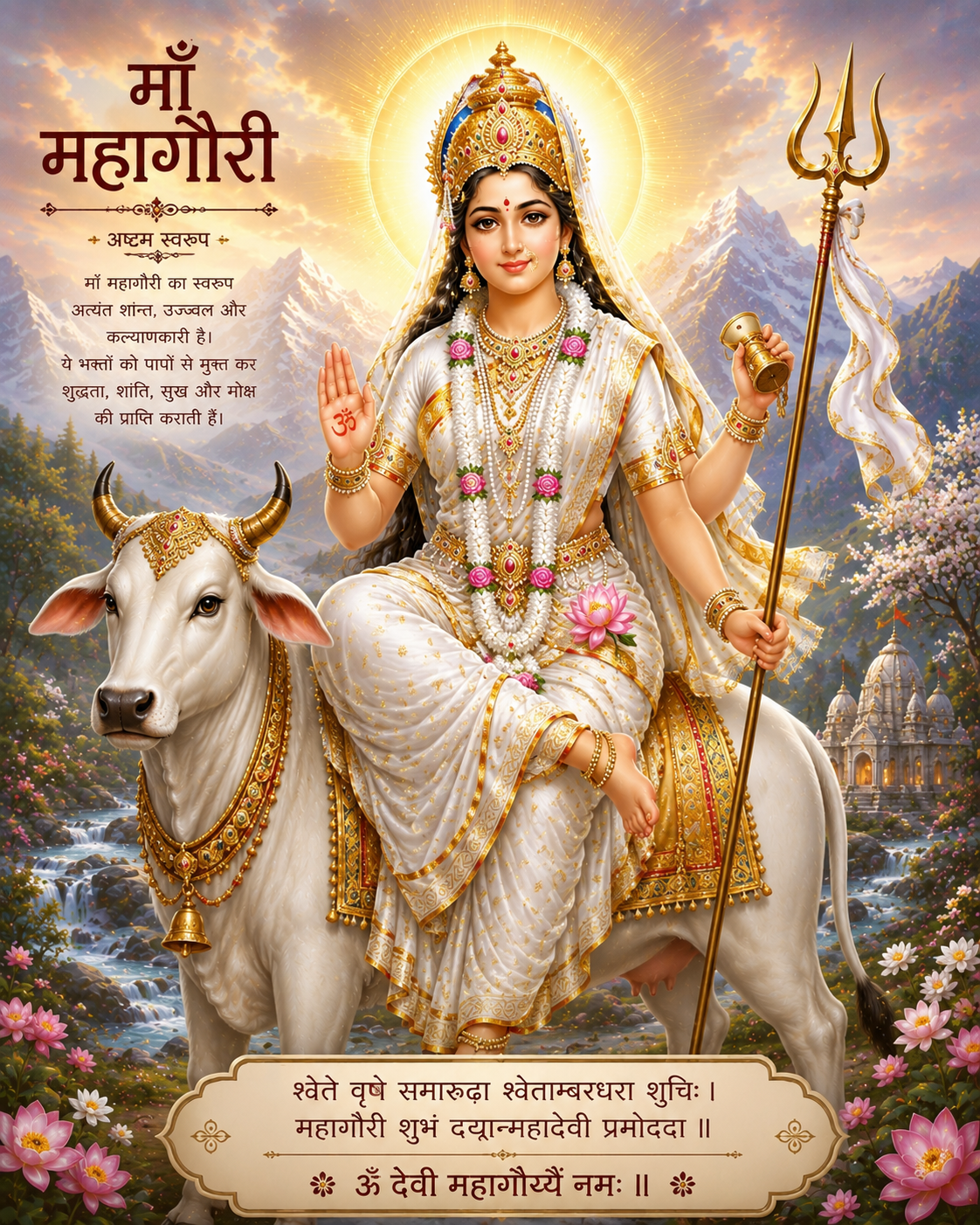
Goddess Mahagauri
Maha Ashtami Special
On the eighth day, Maha Ashtami is observed, and Goddess Durga is worshipped in her Mahagauri form with special rituals. Mahagauri's fair complexion and white garments are traditionally regarded as symbols of purity, peace, and serenity. On this day, Durga Puja reaches a major point of religious observance and devotion.
On Maha Ashtami, Goddess Durga is worshipped according to traditional scriptural rituals and revered in her Mahagauri form. At many Puja sites, special worship, Havan, and other religious rituals are performed on this occasion. The tradition of Kanya Puja is also observed in many places on Ashtami.
🪷 The Tradition of Filling Khoich
Among the important folk traditions observed on Maha Ashtami, "filling Khoich" also holds a special place. In Hindu tradition, married women respectfully fill Khoich before the Goddess while praying for marital well-being, the long life of their husbands, and the happiness, prosperity, and auspiciousness of their families.
This year, Sunday, October 18, 2026, is observed as the day for filling Khoich during Durga Puja. On this occasion, women respectfully offer Khoich to the Goddess and seek her blessings for their married lives and the well-being of their families.
In Mithila and several other regions, this tradition of filling Khoich is regarded as an important part of women's devotion, prayers for family well-being, and dedication to the Goddess during Durga Puja.
Significance:
Goddess Mahagauri is worshipped on Maha Ashtami with a spirit of purity, peace, and auspiciousness. The Khoich ritual on this day is particularly associated with devotion and prayers for family well-being among married women.
Day 9
Navami · October 20, 2026, Tuesday
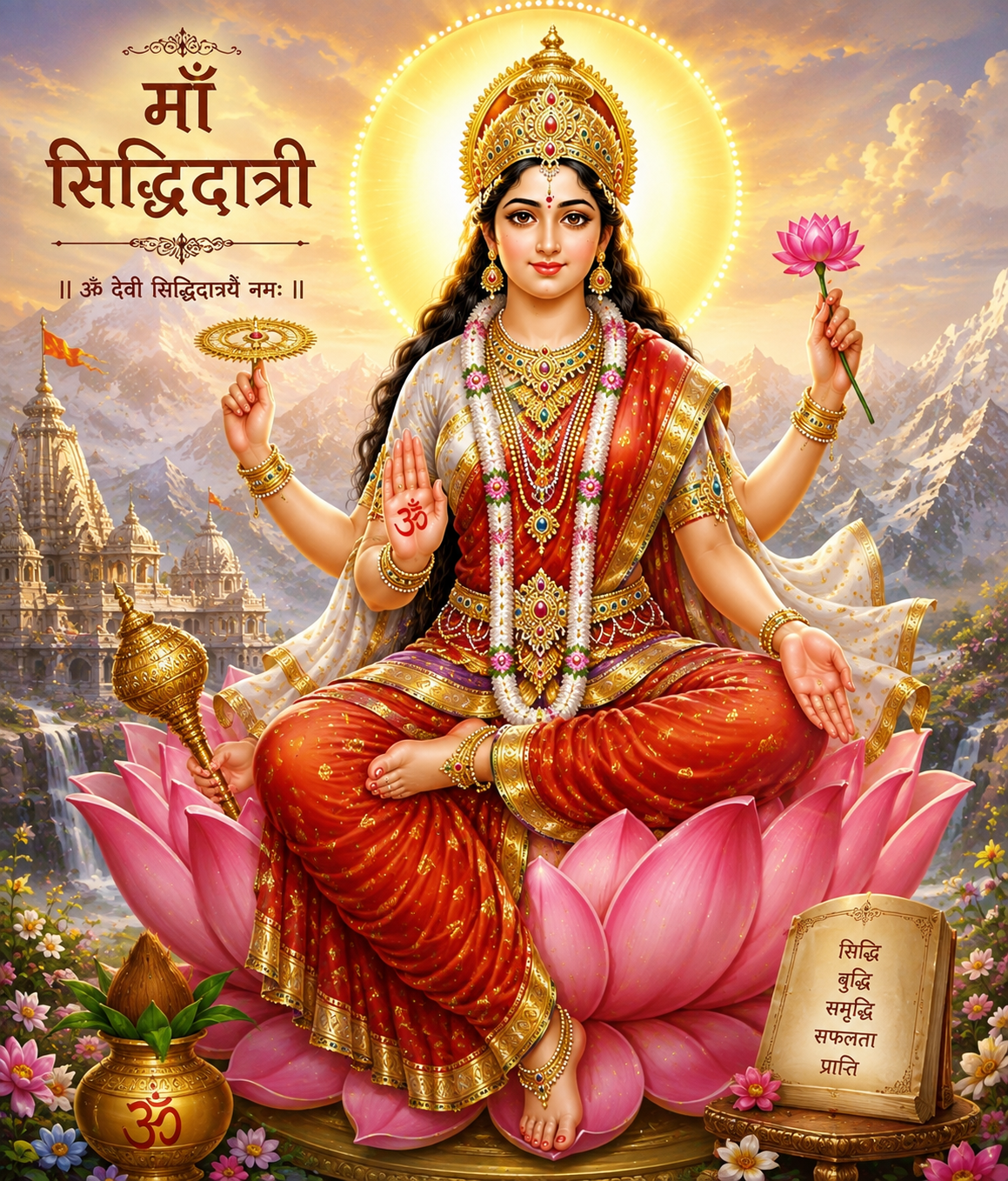
Goddess Siddhidatri
Maha Navami Special
On the ninth and final day, Maha Navami is observed, and Goddess Durga is specially worshipped in her Siddhidatri form. Goddess Siddhidatri is regarded as the final form of the Navdurga and, according to religious tradition, is the Goddess who bestows various Siddhis upon spiritual practitioners. With Maha Navami, the nine-day worship of Navratri reaches its completion.
Dhyana Mantra
सिद्धगन्धर्वयक्षाद्यैरसुरैरमरैरपि।
सेव्यमाना सदा भूयात् सिद्धिदा सिद्धिदायिनी॥
🌺 Special Worship and Fasting Conclusion on Maha Navami
Maha Navami is regarded as the final day of Navratri. Devotees perform special worship and conclude their Navratri fast with Parana. Many devotees visit temples on Maha Navami for Darshan and worship of Goddess Durga and seek her blessings at the completion of nine days of spiritual practice.
In many places, special religious programs are organized in temples on Maha Navami. Depending on local customs and Puja traditions, Havan, Kanya Puja, and other rituals may also be performed.
🪔 Tradition of Sacrifice in Some Regions
Among the diverse traditions of Goddess worship in India, Maha Navami is also associated with sacrifice in some traditions. In certain regions and specific religious traditions, offerings involving sacrifice have historically been made to the Goddess, and in some places the practice continues according to local customs.
However, this is not a tradition followed uniformly throughout India. In many places, symbolic offerings or Sattvic Naivedya are offered instead. Therefore, the rituals performed on Maha Navami can vary according to region, community, and local traditions.
🙏 A Special Day for Devotees
Temples and Puja sites often see a special gathering of devotees on Maha Navami. After nine days of worship, fasting, and spiritual practice, devotees seek Darshan of the Goddess and offer their prayers on this day. In many places, the Navratri celebrations also begin moving toward their conclusion along with the religious rituals of Maha Navami.
Significance:
Maha Navami represents the completion of the nine-day spiritual observance of Navratri. The traditions of worshipping Goddess Siddhidatri, performing Havan, Kanya Puja, and concluding the fast with Parana are observed on this day, as devotees seek the Goddess's blessings and bring their worship and spiritual practice to a close.
Puja Vidhi
Durga Puja Vidhi — In Brief
How to perform a simple Durga Puja at home: the main steps for the nine-day observance.
01
Ghatasthapana
On Pratipada, during the auspicious Muhurta, place water, barley, and Navapatrika in an earthen Kalash.
02
Sankalpa & Invocation
Take the Sankalpa for the vrata, invoke Goddess Durga, and light the Akhand Jyoti.
03
Daily Puja
Each day, meditate upon the Goddess of that day, chant her mantra, and perform the Aarti.
04
Saptashati Recitation
According to your ability, recite the Durga Saptashati or Durga Chalisa every day.
05
Kanya Puja
On Ashtami or Navami, honor nine young girls as manifestations of the Goddess and offer them food and Dakshina.
06
Havan & Parana
Perform Havan on Navami, conclude the fast with Parana, and perform the immersion on Vijayadashami.
FAQ
Frequently Asked Questions
Answers to common questions about Durga Puja 2026.
When is Durga Puja 2026? (Durga Puja 2026 kab hai?)
Durga Puja 2026 will begin with Ghatasthapana on Sunday, October 11, and conclude with Vijayadashami on Tuesday, October 21. In Bengal, the main celebration is observed from Shashthi (October 16) through Dashami (October 21).
What is the difference between Navratri and Durga Puja?
Navratri is a nine-night festival during which the nine forms of Goddess Durga are worshipped, and it is particularly prominent in North and Western India. Durga Puja focuses on the final five days of this period (Shashthi to Dashami) and is celebrated especially in Bengal, Assam, Odisha, Bihar, and Northeastern India with grand pandals and idol installations.
When are Maha Ashtami and Sandhi Puja in 2026?
Maha Ashtami falls on Sunday, October 18, 2026. Sandhi Puja is performed during the Sandhi period, which consists of the final 24 minutes of Ashtami and the first 24 minutes of Navami. For the exact timing, always consult your local Panchang.
When are Maha Navami and Vijayadashami in 2026?
Maha Navami will be observed on Monday, October 20, 2026, while Vijayadashami (Dashami and idol immersion) will be observed on Tuesday, October 21, 2026.
What are the names of the Goddesses worshipped during the nine days of Navratri?
Shailaputri, Brahmacharini, Chandraghanta, Kushmanda, Skandamata, Katyayani, Kalaratri, Mahagauri, and Siddhidatri — collectively known as the Navdurga, the nine forms of Goddess Durga.
On which day should Kanya Puja be performed?
Traditionally, Kanya Puja is performed on Ashtami (October 18) or Navami (October 20). Nine young girls are worshipped as manifestations of the nine forms of the Goddess and are offered food and Dakshina.
What are the rules for fasting during Navratri?
During the Navratri fast, devotees traditionally consume Sattvic foods and avoid grains, onion, garlic, and non-vegetarian food. Fruits, Kuttu (buckwheat) flour, Singhara (water chestnut) flour, Sabudana, and similar fasting foods are commonly consumed. The fast is traditionally concluded with Havan and Parana on Navami.
What is the significance of reciting Durga Chalisa and Durga Saptashati?
Reciting the Durga Chalisa or Durga Saptashati daily during Navratri is traditionally believed to provide spiritual strength, protection, and positive energy. Those who are unable to complete the full Durga Saptashati may recite the Durga Chalisa instead, which is also traditionally regarded as auspicious.
When did Durga Puja start in 2026?
Durga Puja 2026 begins with Ghatasthapana on Sunday, 11 October, marking the first day of Sharadiya Navratri and the ceremonial invocation of Goddess Durga. However, the main Durga Puja celebrations — as observed with grand pandals in West Bengal, Assam, Odisha, and Tripura — start on Shashthi (Bodhan) on Friday, 16 October 2026, and continue through Saptami, Ashtami, and Navami, concluding with Vijayadashami and idol immersion on Tuesday, 21 October 2026.
Are Navami and Dussehra on the same day in 2026?
No, in 2026 Navami and Dussehra fall on separate days. Maha Navami is on Monday, 20 October 2026, while Vijayadashami (Dussehra) follows the next day on Tuesday, 21 October 2026. In some years, Navami and Dashami Tithi can overlap on a single calendar day due to Tithi Kshaya (a shortened lunar day), but in 2026 both Tithis span across separate sunrises, so devotees celebrate them as two distinct, back-to-back days of worship.
How is Durga Maa coming this year 2026?
According to tradition, Goddess Durga's mode of arrival (Agomon) and departure (Gomon) each year is decided by the weekday on which Ghatasthapana and Vijayadashami fall. Since Ghatasthapana 2026 falls on a Sunday, tradition holds that Devi arrives "Gajarohane" — riding an elephant — a Vahana believed to bring good rainfall, a bountiful harvest, and prosperity. Exact interpretations can vary slightly by regional Panchang, so devotees are advised to confirm with their local priest or Panchang.
How is Durga Maa coming this year in 2026?
According to traditional belief, Goddess Durga's arrival and departure are determined by the weekdays of Ghatasthapana and Vijayadashami. In 2026, Ghatasthapana falls on Sunday, so tradition holds that Maa Durga arrives "Gajarudha," meaning she rides an elephant. The elephant is traditionally regarded as a symbol associated with good rainfall, prosperity, and an abundant harvest. For exact details, devotees should consult their local Panchang or priest.
Who did Durga marry?
In Hindu mythology, Goddess Durga is regarded as a fierce, warrior manifestation of Goddess Parvati, the consort of Lord Shiva. As Parvati, she is Shiva's wife and the mother of Lord Ganesha and Lord Kartikeya. While Durga is worshipped independently as the supreme form of Shakti who defeated the demon Mahishasura, theologically she is identified as one with Parvati, which is why Lord Shiva is regarded as her divine husband across Puranic tradition.
What are the 5 days of Durga Puja?
The five core days of Durga Puja are Shashthi, Saptami, Ashtami, Navami, and Dashami (Vijayadashami). In 2026, these fall on 16, 17, 18, 20, and 21 October respectively. Shashthi marks Devi's Bodhan (awakening) and pandal inauguration, Saptami and Ashtami involve elaborate rituals including Sandhi Puja, Navami is marked by Kanya Puja and Havan, and Dashami/Vijayadashami concludes the festival with idol immersion, symbolizing the Goddess's victory over evil and the return of Dharma.
What are the 9 days of Durga Puja?
The nine days of Durga Puja (Navratri) honor the Navdurga — nine forms of Goddess Durga: Shailaputri, Brahmacharini, Chandraghanta, Kushmanda, Skandamata, Katyayani, Kalaratri, Mahagauri, and Siddhidatri, each worshipped with a specific mantra on a designated day from Pratipada to Navami. In 2026, this spans 11 to 20 October, building up through Ashtami and Navami to Vijayadashami on 21 October, which marks the festival's grand conclusion with idol immersion across the country.
On which day will Durga Puja start?
Durga Puja 2026 officially starts on Sunday, 11 October 2026, with Ghatasthapana (Kalash Sthapana) marking the ceremonial beginning of Sharadiya Navratri, when the sacred Kalash and Navapatrika are ritually established. However, the main Durga Puja festivities — especially the grand pandal celebrations observed in West Bengal, Assam, Odisha, and Tripura — begin later, on Shashthi, Friday, 16 October 2026, continuing through Saptami and Ashtami before culminating in Vijayadashami and idol immersion on Tuesday, 21 October 2026.
How many days for Durga Puja 2027?
Based on preliminary Panchang calculations, Durga Puja 2027 is expected around late September to early October, with Mahalaya on Thursday, 30 September 2027. The main five-day celebration is likely to run from Shashthi (around 5 October) through Ashtami (7 October) and Navami (8 October), concluding with Vijayadashami on Saturday, 9 October 2027, while the full Navratri spans nine nights. As these dates are over a year away, please reconfirm closer to the date via a verified Panchang.
What is Belnoti or Bel Nimantran?
In the Durga Puja traditions of Mithila, Belnoti or Bel Nimantran is a special tradition observed on Shashthi. On this occasion, the Bel tree is ritually invited for Goddess worship. According to local belief, the ritual associated with this Bel tree is later connected with the eye form or eye representation of Goddess Durga. On the night of Belnoti, devotees also traditionally stay awake under the Bel tree as part of a night vigil.
What is Beltodi and when is it performed?
Beltodi is a local religious tradition performed on the morning of Saptami, the day after the Belnoti or Bel Nimantran tradition observed on Shashthi. During Belnoti, a Bel tree is ritually invited for Goddess worship, and the Beltodi ritual is performed on the following day. The religious practices and their significance may vary by locality and regional tradition.
When is Mahanisha Puja in 2026?
In 2026, Mahanisha Puja will be observed on the night of October 17, on the occasion of Saptami. In local traditions, it is regarded as a highly significant night dedicated to the Goddess. Devotees may stay awake throughout the night performing worship, mantra chanting, and Yajna. The exact rituals and timing may vary according to the local Panchang or Puja committee.
When is Khoich filled during Durga Puja?
In 2026, Khoich filling during Durga Puja is observed on Sunday, October 18, which is Maha Ashtami. In Hindu tradition, married women may respectfully fill Khoich before the Goddess, praying for marital well-being, the long life of their husbands, family happiness, prosperity, and auspiciousness. The method and items used for Khoich may vary across different regions.
Why is Khoich filled on Maha Ashtami?
Maha Ashtami is an important day of worship dedicated to Goddess Durga. In many Hindu families and regional traditions, married women fill Khoich before the Goddess on this day while praying for marital well-being, family happiness, and auspiciousness. This tradition may be observed in different forms depending on the region and the family's specific Puja practices.
How is the Navratri fast concluded on Maha Navami?
Maha Navami is the final day of the nine-day spiritual observance of Navratri. On this day, devotees worship Goddess Siddhidatri and, according to their tradition, perform Havan, Kanya Puja, and other religious rituals before concluding the fast with Parana. The method and timing of Parana may vary according to the family tradition and local Panchang.
Is there a tradition of animal sacrifice in some parts of India on Maha Navami?
Yes, among the diverse traditions of Goddess worship in India, Maha Navami is associated with animal sacrifice in some regions. This practice is not followed uniformly across India. In some places, sacrifice is performed according to local customs, while many others use symbolic offerings or Sattvic Naivedya instead.
When does the main Durga Puja celebration begin from Saptami?
In many local Puja traditions, the main festive atmosphere of Durga Puja becomes more prominent on Saptami morning when the curtains open for devotees to have Darshan of the Goddess. From this time, fairs, religious programs, and festive activities become increasingly active around Puja pandals. In some places, the tradition of Kumari and Batuk Bhojan also begins from Saptami.
Explore More
Related Mantras and Chalisa
Explore these mantras and devotional texts along with Durga Puja.